

According to the difference in the introduction method, flame retardants can be divided into additive flame retardants and reactive flame retardants. Additive flame retardants are usually incorporated into polymers in a physical way, which is economical and convenient to use, but they generally have poor compatibility with polymers. Defects in the mechanical properties of polymer materials.
Different from the principle of additive flame retardants, reactive flame retardants can form copolymers with monomers or perform a graft reaction on polymers, so that materials can have durable flame retardancy. Moreover, reactive flame retardants have little effect on the mechanical and mechanical properties of polymer materials, and only a small amount can achieve a better flame retardant effect, which is a hot topic in current flame retardant research. This paper mainly introduces the basic flame retardant mechanism of reactive flame retardants and the application status of epoxy resin, polyurethane, cotton fabric and flame retardant paper.
Flame Retardant Mechanism of Reactive Flame Retardants
The combustion process of polymer materials is a complex process with multiphase reaction, which is accompanied by both physical and chemical changes. Reactive flame retardants show different flame retardant mechanisms in different flame retardant systems, which are caused by the differences in the composition of the flame retardants themselves and the material properties of different polymers. But in general, the flame retardant mechanism of reactive flame retardants can be divided into two categories: gas phase mechanism and condensed phase mechanism.
1. Gas phase mechanism
Corresponding to the combustion process, the gas phase flame retardant mechanism of reactive flame retardants includes both physical effects and chemical reactions, and more is the synergistic effect of the two. The physical effect is mainly manifested in that the partially reactive flame retardant can absorb the heat in the environment, decompose and release incombustible gases such as nitrogen, ammonia and carbon dioxide, which can usually dilute the flammable gas at the crack of the polymer material or in the center of the flame. It reduces the concentration of the volatile gas to below the combustion limit, so as to prevent the material from continuing to burn. Sometimes some non-flammable gases also have the effect of heat dissipation, which can reduce the temperature of the surrounding environment.
The chemical effect is mainly reflected in the capture mechanism of free radicals. For example, some phosphorus-based flame retardants can release related free radicals in a high temperature environment and react with H. and O H. that contribute to combustion. In this case, the chain reaction of combustion can be prevented, and the heat released by the flame can be greatly reduced.
2. Condensation mechanism
The flame retardant mechanism of reactive flame retardants has various modes of action in the condensed phase, and carbon formation is the most common mode. Reactive flame retardants can generally greatly increase the char formation of polymers, especially oxygen-containing polymers, such as epoxy resin, cellulose, etc.
The carbon layer is generally formed in the boundary area of the gas phase and the condensed phase, and has a good protective effect. It can be regarded as a protective barrier to prevent oxygen transmission and heat transmission in the air, and achieve the effect of inhibiting the generation of flammable gases. Taking the application of flame retardants on cotton fabrics as an example, it changes the thermal cracking reaction process of the fiber macromolecular chain in the condensed phase, and promotes the dehydration, cross-linking and other reactions, and gradually forms a carbon layer. The amount of carbon residue increased and the amount of combustible gas decreased in the process.
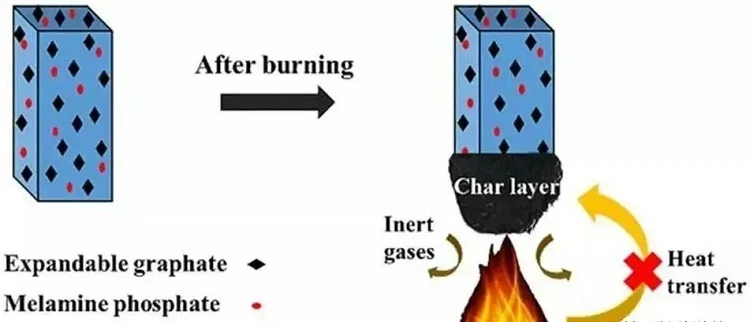
condensed phase charcoal flame retardant
Reactive flame retardants can not only increase the carbon residue, but also promote the anti-oxidation of carbon and prevent carbon from being completely oxidized to carbon dioxide, thereby reducing the heat released by oxidation. In addition to char formation, the action mode of reactive flame retardants in the condensed phase also includes free radical inhibition, the influence mechanism of molten polymer viscosity, and the effect of surface coating.
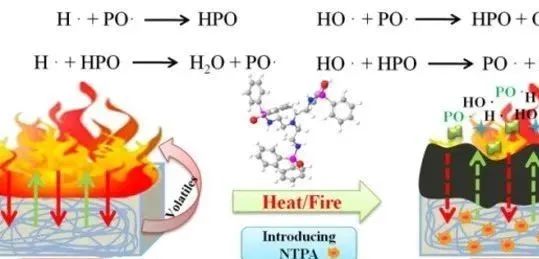
Schematic diagram of flame retardancy such as inhibition of free radicals and char formation
Usually, the main function of reactive flame retardants in flame retardant materials is to generate incombustible gas when the polymer is burned, dilute the concentration of the combustible gas, effectively reduce the thermal effect of the material during combustion and decomposition, and increase the carbonization effect. amount, hindering the transfer of oxygen and heat. In addition, after some polymer materials are treated with reactive flame retardants, the ignition temperature is greatly increased, and the effect of flame retardant is also achieved.
Its Application in Polyurethane
Polyurethane (PU) is a polymer composed of organic units linked by urethane, and has many excellent properties such as good noise resistance, heat insulation and wear resistance. Without flame retardant treatment, the limiting oxygen index (LOI) of polyurethane material is about 18%, which is easy to burn and releases a lot of heat and toxic gases that are harmful to human body. At present, polyurethane reactive flame retardants generally introduce groups with flame retardant functions into the molecular structure of polyurethane through grafting reaction, so as to improve the flame retardant effect and thermal stability of polyurethane materials in high temperature environments.
In the flame retardant modification of polyurethane materials, phosphorus-containing flame retardants are most used, not only have good flame retardant effect but also have low smoke and environmental protection. The principle is to introduce phosphorus into the polyurethane in the form of chemical bonds such as P-O or P-C bonds. In the material structure, these covalent bonds have larger bond energy and stronger stability.
Nitrogen-containing reactive flame retardant flame retardant polyurethane materials generally introduce melamine groups into the polyurethane structure through covalent bonds. Melamine is a stable crystalline compound containing 67% of nitrogen atoms. The temperature reaches 350 ℃. It sublimates, absorbs a lot of energy, and reduces the ambient temperature. And at higher temperatures, melamine decomposes to produce nitrogen and form a thermally stable condensate.
Compared with the introduction of a single flame retardant element, the reactive flame retardant with two or more flame retardant elements is better in terms of flame retardant effect and thermal stability.


