

The Difference Between Swivel Wheels And Omnidirectional Wheels?
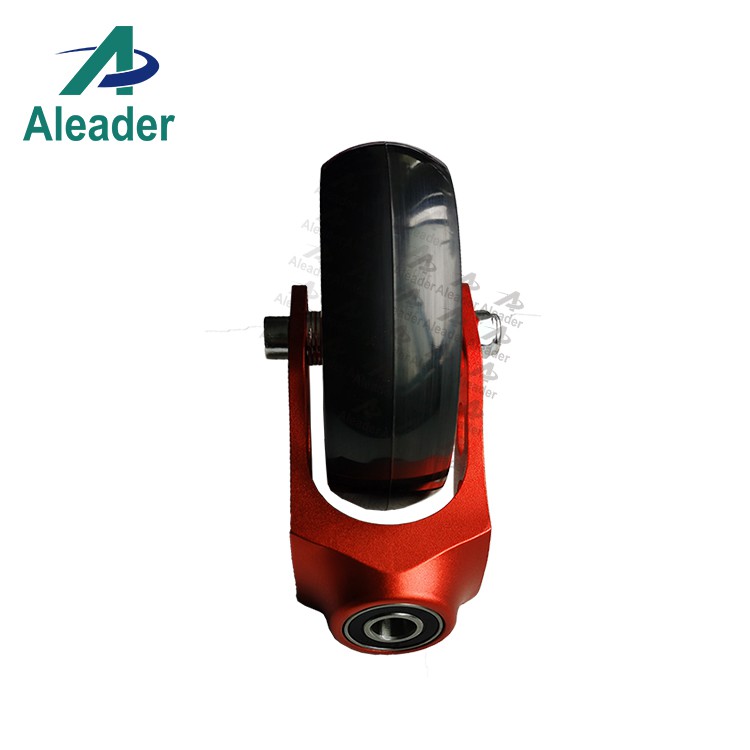
The swivel wheel, as shown in the picture below, realizes its movement mainly by the rolling of the tire; if it turns, it relies on the rotation of the rotating bracket, which drives the change of the direction of the tire and changes the direction of the tire rolling forward. Usually, in the rotating joint of the swivel bracket of the universal wheel, there is a circle of miniature balls (similar to the design of ball bearings), relying on this circle of balls to help the rotation of the swivel bracket.
The installation of swivel wheels on the chassis belongs to a tire-changing installation method, not a directional installation.
As shown in the figure below, the omnidirectional wheel has a circle of balls on the hub of the omnidirectional wheel. When the omnidirectional wheel moves, according to the force vector applied to the omnidirectional wheel, there will be movement in two component directions: including the omnidirectional wheel rolling motion in the direction of the hub, which is the main motion component of the omnidirectional wheel; The direction of the lateral motion component force formed by the ball rolling of the omnidirectional wheel is the secondary motion component force of the omnidirectional wheel. Combining the synthesis of the forces in the directions of the primary and secondary motion components, the actual motion of the omnidirectional wheel is the direction of the vector resultant force of the two component forces.
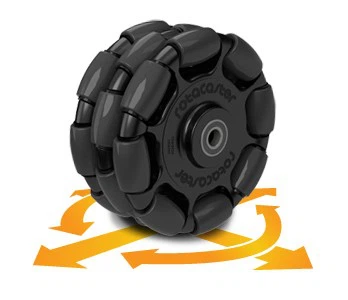
The steering of the omnidirectional wheel is different from that of the swivel wheel. It does not rely on the steering of the swivel joint, but moves and turns by itself according to the vector of the force. Therefore, the omnidirectional wheel performs steering movement under the condition of directional installation
The difference between omnidirectional wheels and swivel wheel steering implementations forms the difference in application of the two.
1. Omni-directional wheels are more controllable in terms of steering direction control and position control.
The swivel bracket of the universal wheel is uncontrollable. Under the influence of comprehensive external factors, in many cases, the swivel joint will not turn to the expected position and direction (for example, foreign objects are stuck in the swivel joint, etc.). Therefore, the steering using the caster is an ambiguous way of steering.
The steering of the omni-directional wheels is completely different, allowing for precise steering control.
2. When using swivel wheels for chassis design and layout, it is necessary to leave enough space for the rotation of the rotating bracket; because the omni-directional wheels are directional installation, this problem will not occur in its layout design. Therefore, the use of omnidirectional wheels allows for a more compact structural design.
3. The rotation radius of the platform using omnidirectional wheels is relatively small, and it can even rotate in situ around its own geometric center. Relatively speaking, if you use swivel wheels, you need a relatively large rotation space. Therefore, omnidirectional wheels have obvious advantages in steering movements in narrow spaces.
4. The load-bearing capacity of the omni-directional wheel is mainly limited by the load-bearing capacity of the small balls on the hub; usually, the load-bearing capacity of the swivel wheel is mainly limited by the load-bearing performance of the swivel joint.
5. Under normal rolling conditions, the driving stability of swivel wheels is better than that of omnidirectional wheels. In the case of swivel wheels, when the plane rolls, the hub is always rolling on a circumferential surface; while in the case of omnidirectional wheels, when the hub rolls, there is a process of crossing from one ball to another. These differences The intersection point of the ball is the error point on the circular motion of the hub. Therefore, the movement of omni-directional wheels is not as smooth as that of swivel wheels. A good omnidirectional wheel structure design will try to reduce the error of these circumferential error points, improve the rolling circularity and improve the driving stability, but these errors cannot be completely eliminated.
6. Compared with the diameter of the wheel hub, the ball diameter of the omnidirectional wheel will be much smaller. Too small diameter will bring challenges to the obstacle clearance height. Therefore, when using an omnidirectional wheel to cross a height obstacle, attention should be paid to controlling the direction, and the diameter of the hub should be used as much as possible to cross the height obstacle, instead of using the lateral movement and rolling of the ball alone to cross the height.
7. When using omni-directional wheels for steering, there will be no phenomenon of tire grinding or tires getting stuck in the gap of the road due to the jamming of the swivel joint. The use of omnidirectional wheels will not cause direction fights between different universal wheels. In the use of the swivel wheel, its rotating joint will always be its weakness in use.
8. Omni-directional wheels are usually used in low-speed scenarios due to the limited diameter of the omni-directional wheels.
9. The wear of omni-directional wheels is more severe than that of normal-working swivel wheels.
Based on the above evaluation and analysis, the swivel caster is the most commonly used steering caster method. However, if there are requirements for steering accuracy and controllability in the application scenario, or for the size of the steering space, or for the compactness of the chassis layout, omnidirectional wheels will perform better than swivel wheels.
At present, the solid swivel wheels manufactured by Aleader Tire have been widely used in the fields of electric wheelschair, robots and smart equipment.


